

.svg)

by Jeanne Bell and Dan Tucker, Co-Founders
AI-generated image, 100% author-created blog content
Blog No. 18 - September 2026
It is a long-acknowledged truth that the executive director job description, as typically written, is undoable. It addresses every core aspect of an organization: governance, strategy, fundraising, staffing, and so on. But since Covid-19 and the subsequent decision by many social justice organizations to let go of in-person requirements and real estate costs, the nature of that undoability has been compounded by a new reality: being a virtual leader (or co-leader in the case of Co-EDs).
Effectiveness as a virtual executive is not to be taken for granted. How do executives embody and convey their leadership without regular in-person face time? How do they ensure virtual staff and board members are clear on priorities, genuinely engaged, and tapped into their accountability to one another? Rather than seeing these as personal leadership challenges, it’s essential to view them as organization design questions1. Executives have to update their organization designs in order to lead virtual organizations effectively.
Design Update #1 - Embrace Your Role as a Convener
In virtual organizations, online meetings are the primary vehicle for executives to embody and convey their leadership to and for the group. It is critical that leaders approach these spaces with intention and energy. In The Art of Gathering, Priya Parker writes: “The kinds of gatherings that meaningfully help others are governed by what I call a generous authority. A gathering run on generous authority is run with a strong, confident hand, but it is run selflessly for the sake of others.”
Asking an assistant to schedule a meeting with others but not designing the meeting in advance is not exercising ‘generous authority.’ Practically, this means ensuring that all meetings have a thoughtful purpose and an agenda sent out in advance. It means setting clear group agreements around meeting attendance and being on camera. It means using inclusive facilitation techniques. It means closing every gathering with clarity: What did we decide? Who committed to what? What are our next steps?
Takeaway: Meeting design and facilitation are critical organization design elements; executives in virtual organizations should model a strong and intentional posture towards them.
Design Update #2 - Embrace Your Role as a Sponsor
In addition to the Convener role for meetings they host, executives have to become strong virtual Sponsors of bodies of work that they don’t manage day-to-day. Often a body of work needs the subject matter expertise and external perspective an executive brings to the table without them needing to be in the weeds of execution.
Especially in virtual organizations, every core body of work needs a Sponsor: a senior staff person with the strategic clarity and organizational influence to help those managing the work to clear obstacles and maintain alignment to the organization's theory of change. Sometimes this will be the executive director; sometimes another senior leader. The key point is not to let groups become unmoored from the organizational whole.
Takeaway: In virtual organizations, it’s easy for teams to lose connection and strategic direction; executives should design Sponsor roles–including for themselves where appropriate–into their organizational structures.
Design Update #3 - Create a Gatherings Role
It used to be that organizations would have one retreat a year, but that was when everyone saw each other all the time. Now, once a year is simply not enough in-person time to build relationships and create shared narratives about the organization and its work.
The truth is that some of the money virtual organizations are saving on real estate needs to be redirected to travel and gathering. Ideally, in-person gatherings would be 4 times per year for staff and at least annually for the board. This requires a meaningful percentage of a staff person’s time directed to planning gatherings. This can no longer be one off; it should be designed into someone’s job. As soon as they finish one gathering, they will have another one to plan!
To register for the board and staff just how significant a part of organization design in-person gathering is, consider making “Board/Staff Gathering” a column in your budget model, as in the simplified example below.
Takeaway: In-person gatherings become a significant time and money investment in virtual organizations; executives should design roles and annual budgets accordingly.
Design Update #4 - Elevate Decision-making Practices
Group decision-making processes are central to organization design. As Niloufar Khonsari advises: “A great starting point is choosing a default method for major decisions, so you’re not reinventing the wheel every time. This one shift can prevent a lot of confusion and miscommunication.”
We find that justice-centered organizations are drawn to modified consensus techniques that allow for gradients of agreement without overly delaying action. To develop a shared practice around this kind of method in a virtual organization requires executive commitment to skilling everyone up on it and then modeling consistent activation during online meetings. (For instance, the image below is taken from the meeting environment on the JustOrg Design platform.)
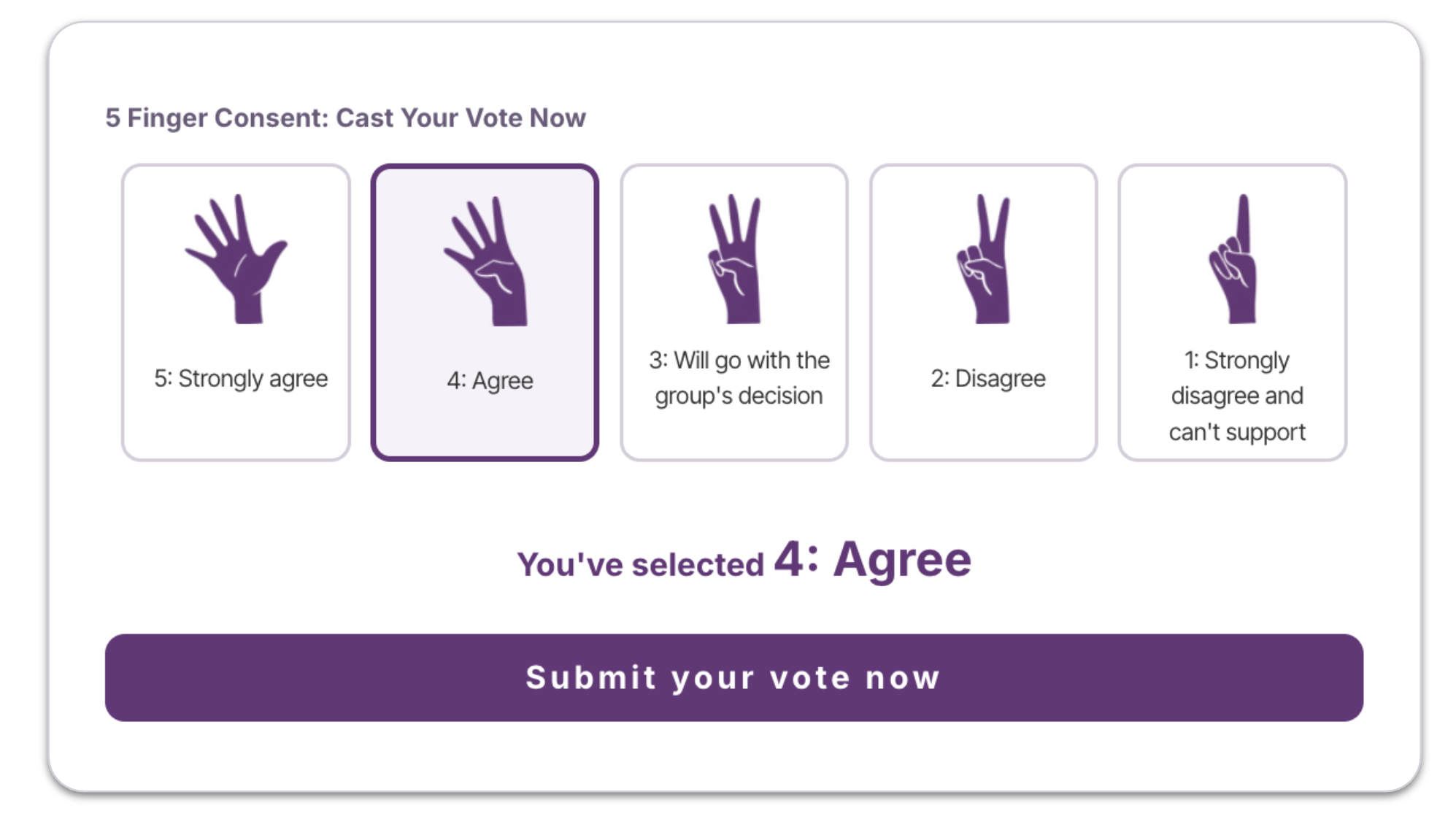
Takeaway: Decision-making was hard enough in person; executives of virtual organizations should build a default method into the organization design. Techniques like 5-finger consent invite everyone to pause in front of key decisions, seek clarity, and lay the groundwork for accountability to implement.
Design Update #5 - Visibilize, Visibilize, Visibilize
Finally, the hardest part of all for executives at virtual organizations is ensuring that everyone can see and feel the work happening across the organization. When people cannot see each other’s work, it leads to isolation, lowered trust, and faulty narratives about who is doing what and to what effect.
It takes executive commitment to use the tools of organization design to visibilize everyone's work, including: clear strategies that everyone applies to their work, role clarity, inclusive meeting design, a default decision-making method, and technology for sharing progress across all teams. Truthfully, there is no more important assignment for a virtual executive.
But one caution on visibility: traditional metrics and dashboards do not amount to visibility in justice-centered organizations. Social change strategies do not lend themselves to excel spreadsheets. Instead, executives have to design virtual organizations to include well-structured time for sharing and debating the work and optimize the use of technology so that everyone knows in real time what each team is working on.
Many executives found themselves to be virtual leaders in the last several years. This kind of leadership is new to us all. Applying an organization design lens to this new reality ensures that the organization feels and operates like much more than the sum of its virtual parts.
Footnote:
1. The discipline of organization design addresses five interdependent elements: strategy, structure, compensation, key organizational processes, and talent. You can learn more here.
Sign up for our monthly blog here


